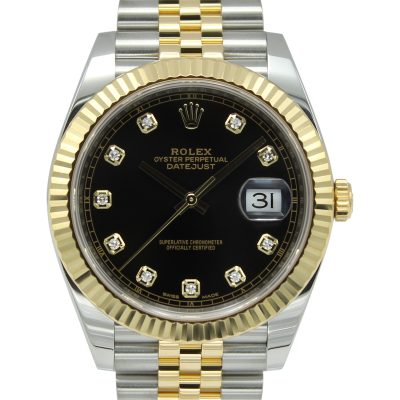
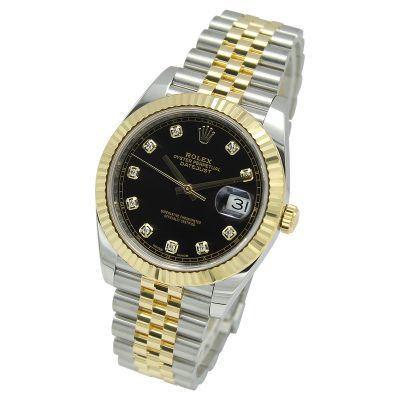
Introduced in 2016 alongside the broader Datejust 41 update, the 126333 brought the Rolesor combination of Oystersteel paired with 18ct yellow gold into the current generation of the collection. That gold runs through the fluted bezel, winding crown, centre bracelet links and clasp, giving the watch a considered warmth rather than the all-or-nothing approach of a full gold watch. Across multiple generations of the two-tone Datejust, it is a balance that has kept the reference consistently popular.
The movement inside is the Calibre 3235, Rolex’s current automatic for the Datejust line, offering a 70-hour power reserve, a bidirectional self-winding rotor and the Chronergy escapement for improved energy efficiency. Buyers comparing it to the older Calibre 3135 found in vintage Datejust references like the 16233 will find it a meaningful step forward in both performance and finishing.
Dial choice for this reference is also quite broad. The Wimbledon, with its slate grey finish and green Roman numerals, has become closely associated with the two-tone Datejust 41 and tends to be the most in-demand configuration on the pre-owned market. Champagne baton, champagne diamond, white baton and black diamond options are also available, each giving the watch a distinct character depending on the occasion you have in mind.
What to Look for When Buying a 126333
Unlike the vintage references elsewhere in the Datejust range, the 126333 is current production, which means examples range from heavily worn pieces through to watches that have never been put on a wrist. That spread gives you more options than you would typically find with a discontinued reference.
If you are looking at unworn examples, check that the watch is complete with box, papers and all accessories, and that stickers and seals are intact where present. A watch in full factory condition carries a real premium over a worn equivalent, and for many that assurance justifies the difference in price.
For worn examples, start with the yellow gold detailing. The centre links of the Jubilee bracelet are the most exposed to daily wear and should be free from significant scratching. The fluted bezel should still have well-defined ridges without signs of over-polishing, and it is worth checking the case around the lugs too, where wear tends to accumulate first on regularly used pieces.
Complete sets with box and papers are more commonly found on the 126333 than on older references, so they are worth holding out for if you can. If there is a specific dial or configuration you are after, get in touch and we can help source it.
How Much Does a Rolex Datejust 41 126333 Cost?
On the pre-owned market, the 126333 typically sits between £12,000 and £17,000. Condition, dial choice and documentation all play a role, with Wimbledon and diamond dial examples generally sitting higher in that range. Unworn stock with full paperwork will push towards the top end.
If you are weighing up the 126333 against the all-steel 126334, the 126333 commands a consistent premium that reflects both the gold content and the stronger demand for two-tone examples. That difference is worth factoring in early when deciding between the two.
For those who are still exploring the wider Datejust 41 family, our Datejust 41 collection covers a comprehensive range of current references, and the full Datejust range is a good starting point if case size is still an open question.